
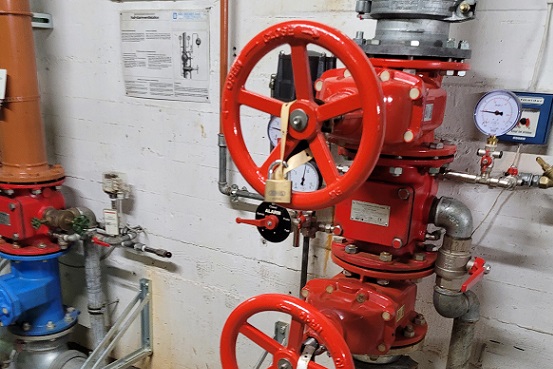
HOAI System Group 7: Fire Suppression Systems | Sprinkler
Within system group 7 of Building Services Engineering, DAMBAN Engineering Office specializes in fire suppression systems of all types as part of engineering services for system group 7 of Building Services Engineering, in accordance with the HOAI, which is simultaneously designated as cost group 474 according to DIN 276.
In this regard, DAMBAN Engineering Office offers not only pure specialist planning or construction supervision, but also all regulatory matters up to the submission of applications or approval procedures for the respective types of fire suppression systems.
Within cost group 474 (Fire Suppression Systems) (System Group 7), the following system groups / system types of this sector are covered:
Hydrant Systems "Dry":
Hydrant systems as "dry systems" for above-ground and underground structures erected for firefighting purposes. All systems serve to provide the fire department with ready-to-use fire suppression pipelines and hydrant systems within the building (operational), to which the fire department connects via fire water supply (hydrant systems in the nearby vicinity), allowing firefighting to proceed effectively within the building.
Hydrant Systems "Wet" or "Wet/Dry":
As previously mentioned, but with an already connected fire water supply, so that the use of nearby hydrant systems (in the vicinity of the building) is unnecessary. The fire water supply is already provided within the building within the fire water and hydrant system and can be used directly by the fire department during firefighting operations.
Above-Ground and Below-Ground Hydrant Systems:
These are fire suppression hydrant systems installed in open areas / outdoor facility areas. They are directly connected to the municipal water supply via underground routing paths. The hydrant systems are available either as "below-ground variants" or "above-ground variants", serving as extraction points for the fire department.
Sprinkler Systems:
Sprinkler systems are installed within buildings and serve for active / automatic fire suppression. A sprinkler control center is established along with a comprehensively planned sprinkler network throughout the building. The system is directly connected to the municipal water supply, including a sprinkler tank/intermediate reservoir, enabling direct supply to individual sprinkler heads. When a fire breaks out in the respective areas, the sprinkler heads in those areas are triggered, automatically spraying fire suppression water. This serves as an additional measure alongside the actual firefighting by the fire department, when required by the fire protection requirements of the respective building use.
For the following construction projects / project types, we offer our comprehensive engineering services / specialist planning services in accordance with the HOAI:
– Residential houses / residential buildings
– Student dormitories / care homes
– Shopping centers
– Logistics centers
– Supermarkets or discount markets
– Warehouses
– Industrial buildings
– Workshops
– as well as other commercial buildings / special-purpose structures.
Planning of Additional TGA Trades from a Single Source
Independent of the systems in cost group 474 (Fire Suppression Systems), we offer you all trades of building services engineering (Building Services Equipment) from a single source. We are thus available to you as a comprehensive TGA overall planner / general planner for your upcoming construction projects – powerful and reliable.
Get off to a Successful Start with Us
Our specialists examine the specific requirements before the project begins in order to avoid premature mistakes. In this way, we aim to optimize the value creation potential of your project and provide you with a
smooth and controlled process flow during planning and construction execution.
DAMBAN Engineering Office – Your Strong Partner for Your Project.
Specialist Planning Sprinkler Systems | Fire Suppression Systems
 Sprinkler System
- Fire Suppression System
- Hydrant System
- Wet Fire Suppression System
- Dry Fire Suppression System
- Below-Ground and Above-Ground Hydrants